The dark web is the part of the internet that can only be reached with special anonymity software like the Tor Browser, using .onion addresses that ordinary browsers and search engines cannot open. It is a small, separate part of the deep web, built to keep both its sites and its visitors anonymous.
- Reachable only through Tor, using .onion addresses
- A tiny, separate layer — not the “hidden 90%” of the internet
- The deep web (email, banking) is different and mundane
- Built for anonymity, used for both good and bad
- Legal to access in most countries
The dark web is one of the most misunderstood terms on the internet, wrapped in myth and exaggeration. Stripped of the drama, it is simply a part of the internet with one defining feature: you cannot reach it with an ordinary browser or find it on Google. It requires special software, and in return it offers anonymity to everyone who uses it — for good reasons and bad.
The simplest definition
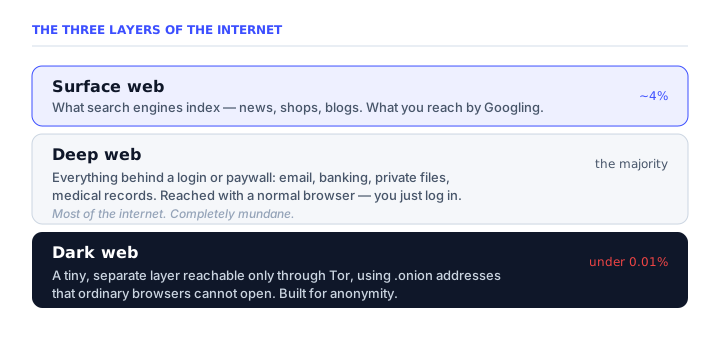
The dark web is the portion of the internet that can only be accessed using specialised anonymity software — most commonly the Tor Browser — and that uses special .onion addresses which ordinary browsers and search engines cannot open. It is deliberately hidden, and it is designed so that neither the people running its sites nor the people visiting them can be easily identified.
Surface, deep, and dark
It helps to place the dark web against the two other layers it is often confused with:
- The surface web is everything a search engine can find: news sites, blogs, shops, public pages. It is what most people mean by “the internet.”
- The deep web is everything behind a login or paywall — your email, online banking, private documents, subscription content. It is reached with a normal browser and makes up the vast majority of the internet. It is also completely mundane.
- The dark web is a small, separate layer that needs Tor to reach at all. It is a tiny fraction of the whole — not the hidden majority the famous iceberg image implies.
Common myth: that the dark web is 90%+ of the internet. That figure describes the deep web — ordinary logged-in content. The dark web is well under 0.01%.
Why it exists
The dark web is built on anonymity, and anonymity is genuinely useful to many people: journalists protecting sources, citizens under censorship, whistleblowers, and privacy-conscious users. It also attracts criminals for exactly the same reason. The technology itself is neutral — it was originally developed by US naval researchers to protect government communications. What people do with it varies enormously, which is why the honest picture of the dark web is neither utopia nor nightmare.
Who uses the dark web, and why
The most revealing question about the dark web isn't what it is but who uses it — because the answer explains why a tool with such a dark reputation is defended by serious people. The users fall into two groups with opposite motives, served equally well by the same neutral technology.
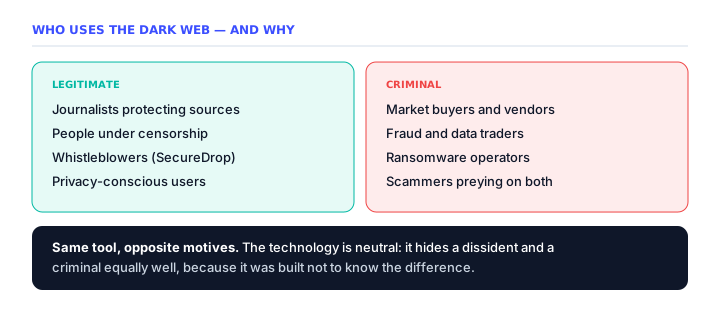
On the legitimate side are journalists protecting sources, citizens under censorship reaching blocked information, whistleblowers using tools like SecureDrop, and ordinary privacy-conscious people who simply don't want to be tracked. Major newsrooms — the BBC, The New York Times — run onion versions of their sites precisely so readers in repressive countries can reach real news safely.
On the criminal side are the market buyers and vendors, fraud and stolen-data traders, and ransomware operators the headlines focus on — plus the scammers who prey on both. This side is real and serious, but it's a policed minority, not the whole. The crucial point is that both groups use the same tool for the same reason: anonymity. The technology can't tell a dissident from a criminal, and was deliberately designed not to.
Common misconceptions
Because the dark web is so misunderstood, a handful of false ideas come up constantly. Clearing them away is half of understanding the subject:
| The myth | The reality |
|---|---|
| “It's 90% of the internet” | That figure describes the deep web; the dark web is under 0.01% |
| “You get hacked just by visiting” | Reading a page is low-risk; danger comes from downloads and logins |
| “It's all criminal” | A large legitimate side exists; most traffic is people reading |
| “Red rooms and hitmen are real” | Overwhelmingly scams and urban legends |
| “Using it is illegal” | Legal in most countries; only illegal conduct is a crime |
How people reach it
Access is straightforward and, in most countries, legal (as is using Tor itself): you download the Tor Browser, which routes your connection through several volunteer relays to hide your identity, and then open .onion addresses. What you do once there determines whether it is safe — reading is low-risk, while downloading files or trusting unverified links is where trouble starts.
The honest big picture
Put together, the dark web is far less mysterious than its reputation. It's a small, deliberately hidden layer of the internet, reachable only through anonymity software, built on a genuinely elegant idea — dividing trust so no one can watch you — and used by people at both ends of the moral spectrum. It is neither the boogeyman of the headlines nor the pure freedom-tool its advocates describe. It's infrastructure: neutral, powerful, and defined entirely by what people choose to do with it.
If you want to go deeper, the natural next steps are understanding how it works technically, seeing what's actually on it, or — if you have a genuine reason — learning how to access it safely. And if a claim about the dark web ever sounds like something from a film, it almost certainly is.
Frequently asked questions
What is the dark web in simple terms?
The dark web is a small, encrypted part of the internet that is not indexed by standard search engines and can only be reached through anonymity software such as the Tor Browser. It uses the special .onion top-level domain, which is resolved only inside the Tor network. Because traffic is relayed through multiple volunteer-run nodes and encrypted at each step, the user's IP address and physical location are hidden. It is a subset of the deep web, not a separate internet, and represents only a tiny fraction of all online content.
Is the dark web the same as the deep web?
No. The deep web includes all pages that are not indexed by conventional search engines: private email inboxes, online banking portals, medical records, subscription services, corporate intranets, academic databases, and government archives. It makes up the vast majority of the internet. The dark web is a much smaller, intentionally hidden layer within the deep web that requires special software like Tor to access and uses .onion addresses. Treating the two terms as synonyms is one of the most common misunderstandings about internet privacy.
What is the dark web used for?
The dark web is used for both lawful and unlawful activities. Legitimate uses include bypassing internet censorship, protecting journalists and their sources, secure whistleblowing, private communication for human rights activists, and anonymous research. Criminal uses include marketplaces for illegal drugs, stolen credentials, counterfeit documents, malware distribution, and fraud. The same anonymity that shields a dissident from surveillance also shields a criminal from law enforcement, which makes the technology ethically neutral.
Is it illegal to access the dark web?
In most democratic countries, simply accessing the dark web with the Tor Browser is legal. The United States, Canada, the United Kingdom, and most European Union member states do not prohibit the use of anonymity software. What is illegal is committing crimes while using it, such as purchasing contraband, laundering money, or distributing illegal material. Some authoritarian governments restrict or block Tor, but even there the legal risk is usually tied to political activity, not to the technology itself.
How do you get on the dark web?
You start by downloading the Tor Browser from its official source, torproject.org, and installing it on your computer or phone. Then you open the browser and enter a known .onion address; unlike ordinary URLs, these addresses are long strings of letters and numbers ending in .onion. Browsing text pages is generally low risk, but you should avoid downloading files, entering personal information, logging into real accounts, or clicking unknown links. If Tor is blocked in your country, you can use a bridge or a pluggable transport to connect discreetly.
Who uses the dark web?
Users fall into two broad groups. Legitimate users include investigative journalists protecting anonymous sources, whistleblowers submitting documents, human rights defenders under censorship, law enforcement agencies conducting investigations, and ordinary citizens concerned about privacy. Criminal users include operators of contraband marketplaces, fraudsters selling stolen data, ransomware groups coordinating payments, and illicit services. Many major news organizations also operate .onion versions of their websites so that readers in repressive countries can access journalism without being tracked.
Is the dark web dangerous?
It can be dangerous if used carelessly. The dark web hosts many malicious websites, scam marketplaces, and links to illegal content. Users may encounter malware, phishing attempts, or law enforcement operations. The risk is low if you only read public text pages, never download files, never share personal information, and stick to well-known .onion addresses. The Tor network itself is not inherently dangerous; unsafe user behavior and unverified links are the main sources of harm.
Why was the dark web created?
Onion routing, the technology behind the dark web, was developed in the mid-1990s by researchers at the United States Naval Research Laboratory, including Paul Syverson, Michael Reed, and David Goldschlag. The goal was to protect U.S. government communications from traffic analysis and surveillance. A network used only by government personnel would have been useless for anonymity because any traffic on it would be obviously official. To create a larger anonymity set, the technology was released to the public and later developed into the Tor network, which is now maintained by the non-profit Tor Project and used by millions of people worldwide.